



A personal injury attorney is preparing for mediation in what appears to be a strong case. The client sought treatment immediately after the accident, underwent months of physical therapy, and accumulated significant medical expenses. However, when opposing counsel reviews the records, they identify unexplained treatment gaps, conflicting provider notes, and missing documentation connecting the injuries to the incident. What should have been straightforward damages claim suddenly becomes a debate over causation.
Situations like this are more common than many firms realize. Medical records often arrive from multiple providers, specialists, imaging centers, and pharmacies, creating a complex paper trail that can be difficult to follow. Without a clear timeline of medical events, attorneys may spend valuable hours piecing together treatment histories while critical details remain buried in hundreds of pages of records.
Medical chronologies solve this challenge by organizing medical evidence into a structured, date-ordered narrative. By presenting a clear picture of injury progression, treatment history, and recovery, they help legal teams strengthen causation arguments, evaluate damages more effectively, and approach negotiations with greater confidence.
What Is a Medical Chronology in a Personal Injury Case?
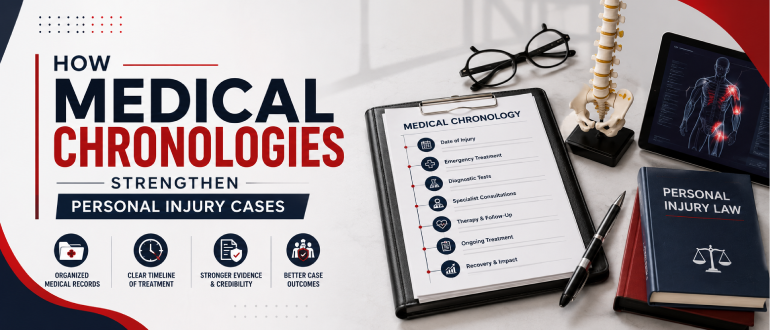
A medical chronology is a structured, date-ordered timeline of all medically relevant events related to a personal injury claim. It organizes information from medical records into a clear sequence, allowing attorneys and legal teams to quickly understand how an injury developed, how it was treated, and what impact it continues to have on the claimant.
Rather than reviewing hundreds of pages of records from multiple healthcare providers, attorneys can use a medical chronology to identify key events, treatment milestones, diagnostic findings, and recovery progress at a glance. This creates a clear connection between the accident, the resulting injuries, and the medical care that followed.
A comprehensive medical chronology typically includes:
- Date and description of each medical event
- Healthcare provider and treatment facility information
- Diagnoses, symptoms, and clinical findings
- Diagnostic tests and imaging results
- Treatments, procedures, and prescribed medications
- Rehabilitation and ongoing care
- Pre-existing medical conditions relevant to the claim
- References to supporting medical records and source documents
By transforming complex medical documentation into an organized timeline, medical chronologies provide a foundation for evaluating causation, assessing damages, preparing demand packages, and supporting litigation strategy throughout the life of a personal injury case.
Why Medical Chronologies Are Critical to Personal Injury Litigation
In personal injury litigation, medical records do more than document treatment—they serve as evidence. The challenge is that evidence is only valuable when it can be clearly understood and connected to the legal arguments being made. Medical chronologies help bridge that gap by transforming complex medical documentation into a structured timeline that supports case strategy.
1. Establishing Causation
One of the most important elements of any personal injury claim is proving that the accident directly caused the injuries being claimed. A medical chronology helps attorneys establish this connection by presenting a clear timeline of symptoms, diagnoses, treatments, specialist consultations, and recovery progress. When medical events are organized chronologically, it becomes easier to demonstrate how the injury developed following the incident and to address challenges raised by opposing counsel.
2. Supporting Damages Assessment
Medical chronologies also provide a comprehensive view of the claimant’s treatment journey. By documenting emergency care, follow-up appointments, diagnostic testing, rehabilitation, medications, and ongoing treatment, they help attorneys evaluate the full extent of economic and non-economic damages. This information becomes particularly valuable when preparing demand packages, settlement negotiations, and expert witness reviews.
3. Improving Case Preparation and Efficiency
Personal injury cases often involve records from multiple providers, facilities, and specialists. Reviewing thousands of pages of documentation can consume significant attorney and paralegal time. A well-prepared chronology highlights the most relevant medical facts, enabling legal teams to identify key issues quickly and focus their attention on case strategy rather than administrative review.
4. Strengthening Negotiations and Mediation
Settlement discussions are often influenced by how effectively medical evidence is presented. A clear chronology helps insurers, mediators, and opposing counsel understand the progression of injuries and the medical care required. When the medical story is easy to follow, attorneys are better positioned to support their valuation of the claim and negotiate from a position of strength.
Simply put, medical chronologies turn raw medical records into actionable litigation support. They provide clarity, improve efficiency, and help legal teams build stronger arguments from intake through resolution.
What a Strong Medical Chronology Must Include
Not all medical chronologies provide the same value. A strong chronology does more than arrange medical events by date; it presents a complete, defensible record of the claimant’s medical journey while highlighting the information most relevant to the case.
The following elements are essential to creating a chronology that supports effective personal injury litigation:
| Element | Why It Matters |
| Date-Ordered Timeline | Creates a clear sequence of medical events and helps establish causation. |
| Provider and Facility Details | Identifies where treatment occurred and allows quick verification of records. |
| Diagnoses and Clinical Findings | Documents the nature and severity of injuries. |
| Diagnostic Tests and Imaging Results | Supports injury claims with objective medical evidence. |
| Treatment History | Tracks surgeries, therapies, medications, and ongoing care. |
| Pre-Existing Conditions | Distinguishes prior health issues from accident-related injuries. |
| Treatment Gaps and Explanations | Helps address questions that may arise during negotiations or litigation. |
| Bates References and Source Citations | Allows attorneys to quickly locate and verify supporting records. |
Beyond these core components, an effective medical chronology should tell a coherent medical story. It should clearly demonstrate the claimant’s condition before the incident, the immediate medical response, the progression of treatment, and any lasting effects that contribute to damages.
When prepared correctly, a medical chronology becomes more than a record review tool—it becomes a strategic resource that supports case evaluation, demand preparation, mediation, and trial readiness.
Common Mistakes That Weaken Medical Chronologies
Even experienced legal teams can encounter challenges when preparing medical chronologies. Small gaps, inconsistencies, or missing details can create opportunities for opposing counsel to question causation, damages, or the overall credibility of the claim.
Some of the most common mistakes include:
1. Incomplete Record Collection
A chronology is only as reliable as the records behind it. Missing specialist notes, imaging reports, pharmacy records, or therapy documentation can leave critical gaps in the claimant’s medical story and create an incomplete picture of treatment.
2. Ignoring Pre-Existing Conditions
Pre-existing conditions do not automatically weaken a personal injury claim. However, failing to clearly distinguish between prior health issues and accident-related injuries can make it difficult to demonstrate how the incident aggravated or worsened an existing condition.
3. Inconsistent Formatting
When chronologies are prepared using different formats across cases, information becomes harder to review, compare, and update. Standardized formatting improves readability and allows attorneys to locate key facts quickly during negotiations, depositions, and trial preparation.
4. Failing to Explain Treatment Gaps
Gaps in medical care are often scrutinized by insurance carriers and defense counsel. Without proper context, they may argue that the injuries were not serious or that the claimant’s condition improved sooner than alleged. Documenting the reasons behind treatment interruptions can help address these challenges.
5. Missing Bates References
Chronology entries should always be supported by source citations. Without Bates references or clear record citations, attorneys may spend valuable time searching for supporting documents, and critical findings can become difficult to verify during litigation.
6. Starting the Process Too Late
Many firms begin chronology preparation during discovery or shortly before mediation. By that stage, attorneys may already be working with incomplete information. Building a chronology early in the case allows legal teams to identify missing records, evaluate causation issues, and develop stronger litigation strategies from the outset.
AI-Powered Medical Chronologies: The 2026 Shift
The volume of medical documentation involved in personal injury litigation continues to grow. A single case may include records from hospitals, specialists, diagnostic imaging centers, rehabilitation providers, pharmacies, and primary care physicians. Reviewing and organizing this information manually can be time-consuming, particularly when legal teams are managing large caseloads.
As a result, AI-powered medical chronologies are becoming an increasingly valuable part of the litigation support process. Rather than replacing human review, AI helps accelerate the extraction, organization, and analysis of medical data, enabling legal professionals to work more efficiently while maintaining accuracy.
Some of the keyways AI is transforming medical chronology preparation include:
- Rapid medical record review by identifying relevant dates, treatments, diagnoses, and provider information across large record sets.
- Automated timeline creation that organizes medical events into a structured chronological format.
- Identification of treatment gaps that may require further investigation or explanation.
- Detection of pre-existing conditions and their relationship to accident-related injuries.
- Faster access to case-critical information for demand preparation, mediation, and trial strategy.
- Improved consistency through standardized chronology formats across multiple cases.
However, technology alone is not enough. Medical chronologies still require experienced human review to validate findings, preserve context, and confirm that the final chronology accurately supports the case’s legal strategy.
By combining AI-driven efficiency with litigation support expertise, legal teams can reduce administrative workloads, accelerate case preparation, and gain faster access to the medical insights needed to support stronger personal injury claims.
The Real Cost of Poor Medical Chronology Preparation
The value of a medical chronology becomes most apparent when it is missing. Even strong personal injury claims can face unnecessary obstacles when medical records are disorganized, incomplete, or difficult to interpret.
One North American personal injury practice experienced these challenges firsthand. Although the firm handled a high volume of complex injury matters, attorneys and support staff often spent significant time reviewing medical records, tracking treatment histories, and preparing documentation for mediation and settlement discussions.
The lack of a structured medical chronology process created several recurring issues:
| Challenge | Impact on the Case |
| Disjointed or incomplete timelines | Made it harder to establish causation and accurately assess damages |
| Missing critical deadlines | Increased the risk of procedural delays and adverse outcomes |
| Inconsistent documentation formats | Created confusion during case reviews, depositions, and mediation |
| Excessive administrative workload | Reduced the time available for strategy and client advocacy |
| Poor record organization | Slowed case preparation and weakened settlement positioning |
As case volumes increased, these inefficiencies became more difficult to manage. Legal teams spent valuable hours searching through records instead of focusing on case strategy, while inconsistencies in documentation affected overall workflow efficiency.
To address these challenges, the practice implemented a more structured approach to medical chronology preparation. Standardized templates, organized record review processes, and date-ordered chronologies created a clearer view of each claimant’s medical history while improving consistency across cases.
The results were significant:
- 26% increase in average settlement values
- 32% improvement in mediation success rates
- 50% reduction in administrative costs associated with record review
The experience highlights an important reality: medical chronologies are not simply administrative documents. When prepared correctly, they become strategic litigation tools that help attorneys present stronger cases, support damages claims, and improve overall case outcomes.
How LSW Helps Personal Injury Firms
Preparing a medical chronology requires more than organizing records by date. It demands accuracy, consistency, and a clear understanding of how medical evidence supports legal strategy. Legal Support World helps personal injury practices streamline this process by transforming complex medical records into structured, litigation-ready chronologies that support case evaluation, settlement negotiations, mediation, and trial preparation.
1. Standardized, Court-Ready Documentation
LSW follows standardized chronology formats designed to improve consistency across cases. This enables attorneys, paralegals, and litigation teams to quickly locate key medical events, review treatment histories, and reference supporting documentation without navigating through hundreds of pages of records.
2. Clear Distinction Between Pre-Existing and Incident-Related Conditions
One of the most challenging aspects of personal injury litigation is demonstrating how an accident caused or aggravated an injury. LSW’s structured medical chronologies clearly separate pre-existing conditions from incident-related injuries, helping legal teams build stronger causation arguments and address potential defense challenges more effectively.
3. Comprehensive, Date-Ordered Medical Timelines
Our chronologies present medical events in a logical sequence, covering emergency treatment, specialist consultations, diagnostic testing, rehabilitation, ongoing care, and other relevant milestones. Each chronology is designed to provide a complete picture of the claimant’s medical journey while maintaining easy access to supporting source documentation.
4. Scalable Support for High-Volume Litigation
Whether managing individual personal injury claims or large caseloads, LSW provides the capacity to handle significant volumes of medical records while maintaining consistent quality and turnaround times. This allows legal teams to focus on advocacy and case strategy rather than administrative record review.
By combining litigation support expertise, structured workflows, and advanced technology, LSW helps personal injury practices convert complex medical records into clear, actionable insights that strengthen case preparation and support better outcomes.
Conclusion
Medical chronologies play a critical role in personal injury litigation by transforming complex medical records into clear, organized timelines that support causation analysis, damages assessment, and case strategy. When prepared accurately, they help legal teams identify key medical events, address potential weaknesses, and present stronger evidence during negotiations, mediation, and trial preparation.
Discover how our medical chronology services can streamline your litigation workflow and help your team build stronger personal injury cases.
