



Litigation teams succeed when their most experienced attorneys spend time on client counselling, advocacy, negotiations, legal strategy, shaping arguments, and appearances not searching through hundreds of judicial opinions. However, many attorneys still dedicate a significant portion of their time to legal research, even though these tasks can often be completed more efficiently through specialized support. Choosing to outsource legal research allows firms to redirect high-value legal talent toward the work that directly influences case outcomes and client relationships.
Outsourcing legal research means delegating case law analysis, memo drafting, and cite-checking to external legal professionals, typically reducing research costs by 40–60% while freeing senior associates for trial strategy.
Rather than cutting corners, this approach helps law firms allocate resources more strategically. Dedicated research paralegals can quickly locate statutes, regulations, precedents, and secondary sources, accelerating litigation and transactional work and attorneys can focus on more strategic work. This parallel work of attorneys and research paralegals enables attorneys and paralegals to work simultaneously when attorneys devise strategies and paralegals create research memoranda, both formal and informal, based on the strategy and this partnership accelerates preparation of and improve overall productivity and efficiency.
Key Takeaways
- Attorneys can spend 15–20 hours each week on legal research tasks that could be delegated more cost-effectively
- Law firms that outsource legal research can typically reduce research costs by 40–60% compared to using in-house senior associate time.
- Follow-the-sun delivery models enable research memoranda to be ready before morning strategy meetings, helping teams meet tight litigation deadlines.
- Legal Support World provides ISO 27001 and SOC 2-certified legal research support to law firms across all 50 U.S. states.
- Outsourcing routine research allows senior associates to focus on trial strategy, witness preparation, motion planning, and client counseling.
- Dedicated research paralegals can quickly locate statutes, regulations, precedents, and secondary sources, accelerating litigation and transactional work.
- Knowledge management by creation of precedent banks, and practice area based research, jurisdiction-based research and issue-based research that benefit future matters.
- Scalability is another benefit where law firms and attorneys can meet research requirements during large litigation, due diligence, regulatory reviews, investigations or arbitration matters without increasing the additional headcount.
- Paralegals will manage the risk while verifying statutory amendments, recent judgments, procedural requirements before attorney review, reducing research errors.
What Does It Cost When Senior Associates Do Routine Research?
Assigning routine legal research to paralegals comes at a significant opportunity of cost. Every hour spent reviewing case law or drafting research memoranda is an hour taken away from trial preparation, legal strategy, client counseling, or business development.
Attorneys at many U.S. litigation firms commonly bill between $300 and $500 per hour, depending on the firm’s size, market, and practice area, according to industry billing rate surveys and legal market analyses. As corporate clients become more cost-conscious, they increasingly question invoices that bill senior-level rates for research-intensive work.
The Hidden Cost of In-House Research
Instead of focusing on high-impact litigation tasks, attorneys often spend valuable time on:
- Reviewing case law and judicial opinions
- Analyzing statutes and regulations
- Drafting legal research memoranda
- Verifying citations and legal authorities
- Tracking recent statutory amendments
Many firms are addressing this challenge by reallocating research work to specialized legal professionals. In fact, outsourcing legal research is 40% cheaper than in-house associates, allowing attorneys to concentrate on courtroom strategy and client advocacy.
What Is Legal Research Outsourcing and What Does It Cover?
When law firms outsource legal research, they retain complete control over legal strategy while delegating research-intensive tasks to experienced legal professionals. As explained in our case law research workflow, effective research begins with a clearly defined legal issue, jurisdiction, and scope before moving into analysis and drafting.
A typical engagement can include:
- Case law research to identify relevant precedents and judicial opinions.
- Statutory and regulatory analysis across federal, state, or jurisdiction-specific laws.
- Legal memoranda that summarize research findings and highlight key legal issues.
- Cite-checking and authority verification to ensure every citation is accurate and up to date.
- Comparative legal research across jurisdictions
- Industry and regulatory compliance research
These services are designed to complement, not replace the work of attorneys. Attorneys continue to evaluate legal arguments, make strategic decisions, and advise clients, while research professionals provide the analytical foundation needed to support those decisions.
Learn more about our legal research and writing services to see how Legal Support World helps litigation teams deliver high-quality legal work more efficiently.
How Does Outsourcing Free Senior Associates for Trial Strategy?
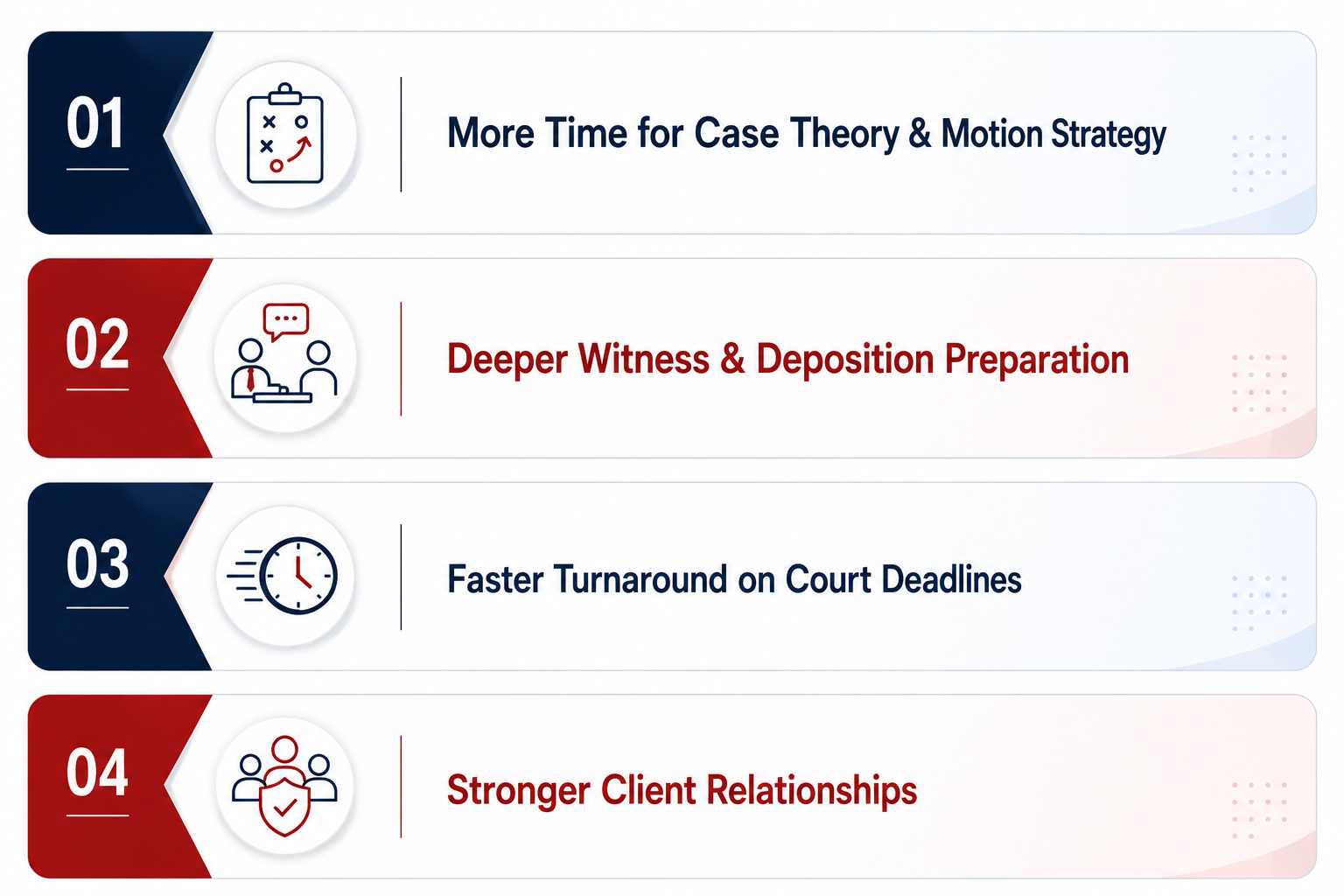
The biggest advantage of outsourcing legal research is that it shifts time-consuming tasks away from senior associates without removing them from the decision-making process. Instead of spending hours locating precedents, analyzing statutes, or verifying citations, attorneys receive well-organized research memoranda that they can validate and use to shape a stronger trial strategy. This allows experienced litigators to focus on the legal judgment, advocacy, and client-facing work that directly influences case outcomes.
1. More Time for Case Theory & Motion Strategy
Developing a persuasive case theory requires critical thinking, legal experience, and a deep understanding of the client’s objectives. By reviewing synthesized research instead of compiling, it from scratch, senior associates can spend more time refining arguments, identifying legal risks, and strengthening motions before they reach the courtroom.
2. Deeper Witness & Deposition Preparation
Preparing witnesses and planning depositions often determine how effectively a case unfolds at trial. The hours saved through outsourced research can be redirected toward developing deposition outlines, anticipating opposing counsel’s arguments, and preparing witnesses to testify with confidence.
3. Faster Turnaround on Court Deadlines
Litigation deadlines leave little room for delays. Many legal research providers operate using a follow-the-sun delivery model, allowing research assignments submitted at the end of one business day to be completed overnight. Teams arrive the next morning with research memoranda ready for review, helping attorneys respond quickly to filing deadlines and last-minute developments.
4. Stronger Client Relationships
When attorneys spend less time compiling citations and more time advising clients, communication improves. Partners can focus on explaining legal strategy, discussing case developments, and building trust rather than updating clients on administrative progress.
How the Process Works
- The law firm shares a research brief outlining the legal issue, jurisdiction, scope, and deadline.
- The outsourced legal team conducts the research and delivers a synthesized memorandum, often overnight.
- The senior associate reviews the findings, applies legal judgment, and develops the final trial strategy supported by comprehensive research.
When combined with comprehensive litigation support services, outsourced legal research helps firms improve efficiency while ensuring attorneys remain focused on high-value litigation work.
The Business Case in Numbers
For many firms, the decision to adopt outsourced legal research for law firms comes down to balancing cost, speed, and scalability. Rather than expanding headcount to manage fluctuating workloads, firms can access experienced legal professionals on demand while keeping overhead under control. When paired with paralegal outsourcing services, this model creates a cost-effective support structure for routine legal work, allowing attorneys to concentrate on strategic litigation.
| Hourly Cost | $300–500/hour | Fraction of associate rate |
| Turnaround | Business hours | Overnight / Follow-the-sun |
| Scalability | Hiring cycles | On-demand capacity |
| Overhead | Salary, benefits, training | No long-term employment costs |
A flexible pricing model further enables firms to scale support based on caseload, making it easier to manage both routine matters and spikes in litigation efficiently.
Why Law Firms Choose and Trust Legal Support World
- Seamless workflow integration with platforms such as LexisNexis, Clio, MyCase, Filevine, and PracticePanther.
- Experienced legal professionals who understand U.S. legal research requirements across jurisdictions.
- Human expertise supported by technology, ensuring every research assignment is reviewed for accuracy, context, and legal relevance.
While AI can accelerate information gathering, effective legal research still requires professional judgment. Explore how human expertise vs. AI in legal research works together to deliver reliable, litigation-ready research for modern law firms.
Ready to Strengthen Your Litigation Team?
Contact us today to learn how our legal research experts can help your firm reduce costs, improve turnaround times, and achieve better litigation outcomes